
 English
 中文简体
中文简体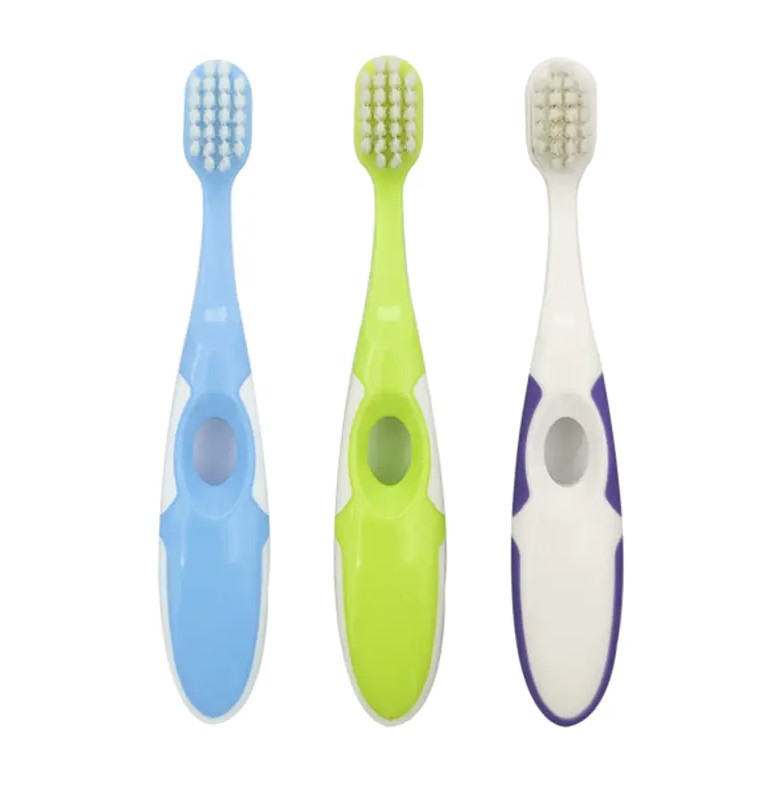
Phone:+86-13952799285
A first tooth usually breaks through somewhere between six and ten months, and the brush that suits it is a different object from the one in your own bathroom. Parents who dread brushing at this age are often fighting the tool rather than the child: a head too wide to reach the back of a small mouth, filaments too stiff for gum tissue that is still forming, or a handle too short for an adult hand to steer. The practical answer is straightforward. For a baby, look for a head roughly 10 to 13 millimetres wide, filament diameters near 0.08 to 0.10 millimetres, and a handle long enough that the parent controls the movement. The rest of this guide shows where those numbers come from and how they shift over the first four years.
Content
- 1 Why a Baby Toothbrush Is Not a Smaller Adult Toothbrush
- 2 Bristle Softness: What the Filament Diameter Actually Tells You
- 3 How Brushing Time Should Change as Your Child Grows
- 4 Head Width and Whether You Can Reach the Back Molars
- 5 Comparing Three Tools for the First Two Years
- 6 Handles, Drying and the Hygiene Problem Nobody Mentions
- 7 A Step by Step Routine for the First Two Years
- 8 What to Check Before You Buy
Why a Baby Toothbrush Is Not a Smaller Adult Toothbrush
Three measurements separate a brush built for a baby from a brush built for adults, and each one solves a different problem. Head width decides whether the brush can sit flat against a molar without pressing into the cheek. Filament diameter decides how much force each bristle tip applies to gum tissue that is only a fraction of the thickness of adult gums. Handle length decides who is actually controlling the motion, and that matters because most children cannot hold a steady grip before about four years of age.
The table below collects the ranges that appear again and again in manual toothbrush specifications. Use them as a shopping filter rather than a rule book.
| Stage | Head width | Filament diameter | Handle length | Who brushes |
|---|---|---|---|---|
| 0 to 12 months, first teeth | 10 to 13 mm | 0.08 to 0.10 mm | 120 to 140 mm | Parent only |
| 1 to 2 years | 13 to 15 mm | 0.10 to 0.12 mm | 130 to 150 mm | Parent, child holds a spare brush |
| 2 to 4 years | 15 to 18 mm | 0.12 to 0.14 mm | 140 to 160 mm | Parent guides, child copies |
| Adult | 22 to 28 mm | 0.18 to 0.22 mm | 180 to 200 mm | Independent |
A super-soft small-head model such as the LB4508 is built around exactly these first-stage numbers, with a head in the 10 millimetre class and filaments at the soft end of the scale. That combination lets a parent finish a full clean in well under a minute, before a tired child starts turning away.
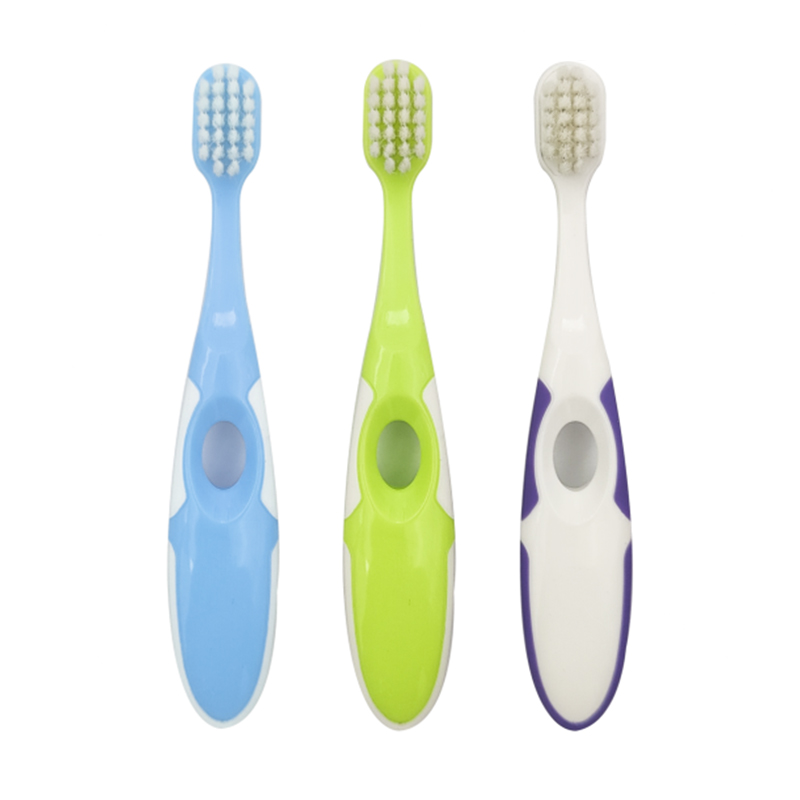 LB-4508 Kids Super Soft Small Head ToothbrushSquare-hole flocking process can clean teeth in high density. The large square-hole pores are suitable for four rows and 7 rows of high-density filament bristles, whic...View Product →
Bristle Softness: What the Filament Diameter Actually Tells You
Diameter is the most honest number you can compare between two brushes, and it is usually printed on the packaging or listed on the product page. Stiffness rises faster than diameter does, so a small change in the measurement produces a large change in how the brush feels on a gum ridge.
The chart places five common brush categories on the same scale. Diameter is worth checking first because it controls how the brush behaves under a light grip, which is the only grip a baby will tolerate. Baby brushes sit at the bottom of the scale for a reason, with typical filaments between 0.08 and 0.10 millimetres. The gap between 0.10 and 0.12 millimetres looks tiny on paper, yet it is often the difference between a child accepting the brush and pulling away. If a manufacturer does not publish filament diameter, look for the words super soft or extra soft, and confirm that the bristle tips are rounded rather than cut flat. Rounding matters as much as softness, because a sharp tip on a soft filament still scratches.
How Brushing Time Should Change as Your Child Grows
The curve shows the brushing time most dental guidance points to at each stage, and its shape matters more than any single value on it. Very young children do not need a two minute session, because the number of teeth is small and the goal at that point is tolerance rather than duration. As molars appear and more surfaces need cleaning, the target climbs steadily, reaching the familiar two minutes around three to four years of age. These figures assume an adult is doing the brushing; a child brushing alone will usually finish far faster and clean far less. If a session regularly ends early, shorten the target first and build it back up over a few weeks instead of forcing the full time. Consistency across seven days is worth more than one perfect session on a Sunday evening.
Head Width and Whether You Can Reach the Back Molars
Head width decides how much of the mouth a single stroke can cover. The columns give typical widths by age group, from roughly 10 millimetres in the first months to 25 millimetres for adults. A six millimetre difference sounds trivial until you realise it is the difference between a brush that fits behind the last molar and one that stops at it. Wider heads clean more surface per stroke, which is why they help older children and adults, but they become a liability in a small mouth where they press into the cheek or trigger a gag reflex. If your child gags during brushing, try a narrower head before changing toothpaste, timing or technique. Width is also the reason a brush should be replaced for size reasons, not only for wear.
Comparing Three Tools for the First Two Years
Red area: small-head super-soft brush. Grey area: adult soft brush. Teal area: gauze or finger brush. Scores run from 1 to 10, higher is better.
The radar compares three approaches across six dimensions, and its purpose is to show trade offs rather than to crown a winner. A small-head soft brush scores well on bristle softness, head fit, gum safety and drying speed, and it holds up reasonably well on back molar reach once the child has a few teeth. An adult soft brush looks acceptable on cleaning power but scores poorly on fit and on parent control, which is the technical reason a soft adult brush is still the wrong tool for a baby. Gauze or a silicone finger brush is excellent on a toothless gum ridge and around the first two teeth, yet it loses badly on molar reach and on drying speed because the material traps moisture. Most families end up owning both a finger brush and a small-head brush and switching between them as teeth arrive. Because the scores are relative, an eight means good inside this comparison, not good in absolute terms.
Where the small-head category is concerned, a soft-bristle cleansing small-head model such as the ALB4511 is a sensible step once the first molars appear and the front teeth are no longer the only target.
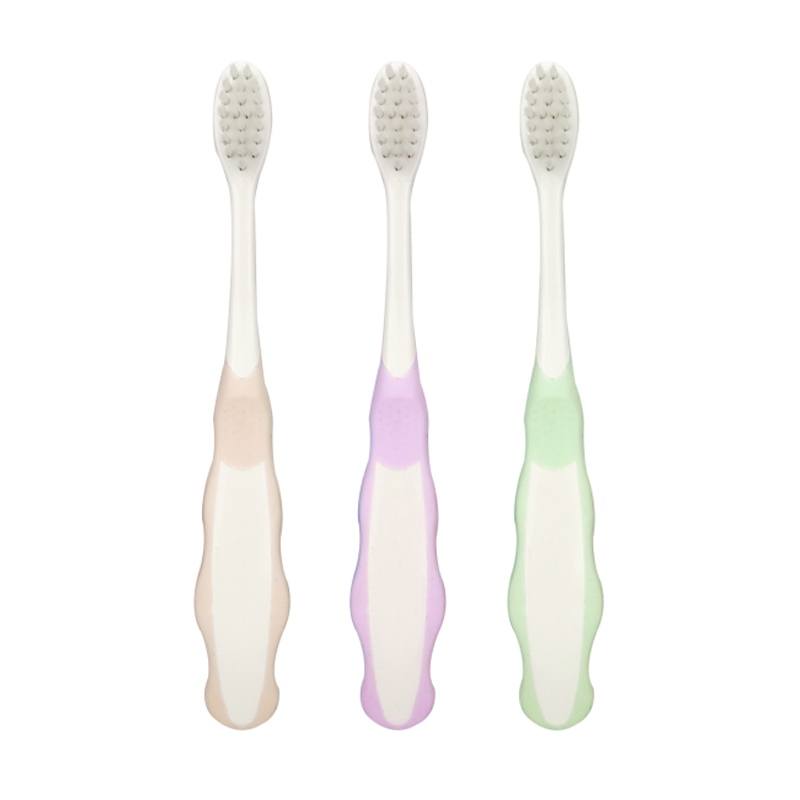 ALB-4511 Children's Soft Bristle Cleansing Small Head ToothbrushHello let's get in touchView Product →
Handles, Drying and the Hygiene Problem Nobody Mentions
A wet brush that never dries is a more common problem than most parents expect. Water sits in the tuft holes after rinsing, and in a closed cabinet that moisture can stay for days, which is the reasoning behind ventilation holes and breathable tuft designs. If the brush is stored in a drawer or a travel case, look for a handle with air channels, and stand the brush upright rather than laying it flat on a shelf.
Handle length deserves the same attention. A 120 to 140 millimetre handle is long enough for an adult to keep a light grip and still reach the back of a small mouth, while very short handles force a tight grip that translates into too much pressure. Replace the brush every three months, and sooner if the bristles have flared or if the child has been ill. For background on how early habits form, the article on soft baby toothbrushes and early oral hygiene habits walks through the same points from a habit-building angle.
Once your child moves past the first teeth and can sit still for a full minute, a slightly larger small-head model such as the ALB4010 fits the same routine without changing your technique.
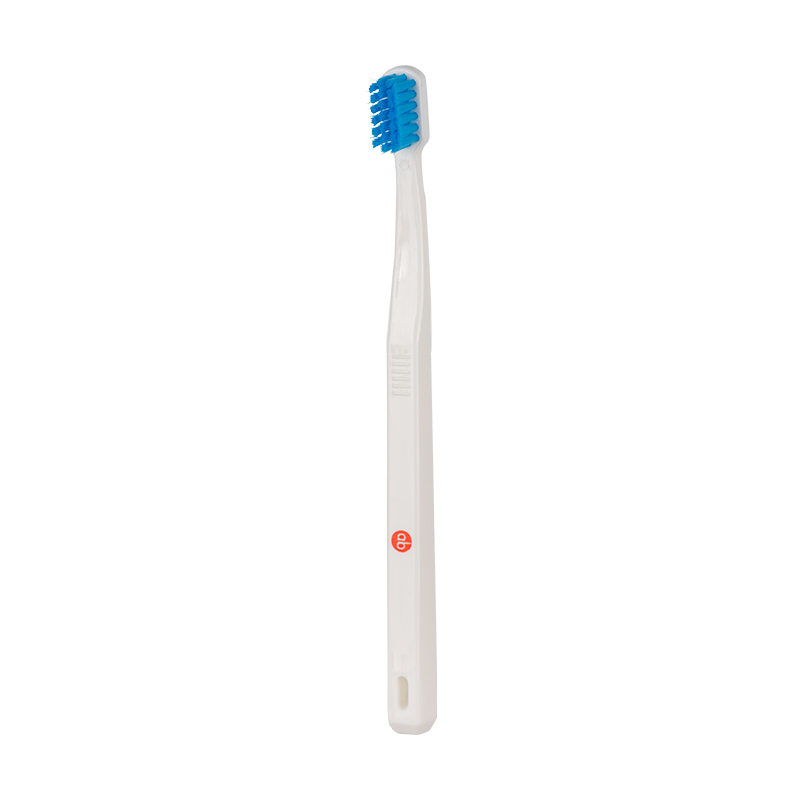 ALB-4010 Children's Clean Tooth Small Head ToothbrushHello let's get in touchView Product →
A Step by Step Routine for the First Two Years
The sequence below takes about a minute once it becomes familiar, and keeping the order identical each day is what makes a small child cooperate.
- Wash your hands and rinse the brush head under warm running water for about ten seconds.
- Sit or stand behind your child with their head resting back against your chest so you can see the upper teeth from above.
- Use a smear of fluoride toothpaste no larger than a grain of rice for children under three.
- Start with the outer surfaces, moving the head in small circles from the back teeth toward the front.
- Repeat on the inner surfaces and the chewing surfaces, steadying the chin with your free hand.
- Rinse the head, shake out the excess water and stand the brush upright where air can reach the bristles.
What to Check Before You Buy
- Head width matched to your child's age, not to how long you hope the brush will last.
- A stated filament diameter, ideally between 0.08 and 0.12 millimetres for children under two.
- Rounded bristle tips and no flat cut ends you can feel with a fingertip.
- A handle of at least 120 millimetres so an adult hand stays in control.
- Ventilation holes or a breathable tuft design if the brush lives in a closed cabinet.
- A replacement date every three months, or sooner if the bristles splay outward.
If you want to compare shapes and sizes side by side before deciding, the kids manual toothbrush range lists head widths and bristle options for each stage, which makes it easier to match a brush to the teeth your child actually has right now.
The single most useful change most parents can make is to stop judging a baby toothbrush by how it looks and start checking three numbers: head width, filament diameter and handle length. A brush that fits inside those ranges makes the daily routine shorter, gentler and far less likely to end in tears. Buy one brush that matches your child today, replace it on schedule, and let the size grow with the mouth rather than with the calendar.