
 English
 中文简体
中文简体
Phone:+86-13952799285
A manual travel toothbrush offers zero charging requirement, airline-compliant size, near-zero weight, and complete independence from electricity or batteries — making it the most reliable and friction-free option for maintaining oral hygiene on the move. While sonic or electric toothbrushes deliver superior plaque removal at home, the manual travel toothbrush wins on portability, convenience, and cost when used away from a fixed base.
Content
- 1 Advantage 1: No Power Source Required — Use Anywhere
- 2 Advantage 2: Compact Size and Minimal Weight
- 3 Advantage 3: Airline and Security Compliant Without Any Restrictions
- 4 Advantage 4: Low Cost Makes It Disposable or Shareable
- 5 Advantage 5: Effective Cleaning When Used with Correct Technique
- 6 Manual Travel Toothbrush vs. Electric Travel Toothbrush: When to Choose Each
Advantage 1: No Power Source Required — Use Anywhere
A manual travel toothbrush requires no batteries, no charging cable, and no access to an electrical outlet. This makes it genuinely usable in every environment where oral hygiene is needed on the road:
- Camping and outdoor travel — no power infrastructure available; a manual brush works equally well at a mountain campsite as in a hotel bathroom.
- Long-haul flights — brushing in an airplane lavatory is common on overnight international flights; no battery risk, no power adapter needed.
- Countries with different electrical standards — a manual brush avoids the need for voltage converters or plug adapters entirely.
- Multi-day backpacking or expedition travel — where every gram of bag weight and every cubic centimeter of pack space matters.
Advantage 2: Compact Size and Minimal Weight
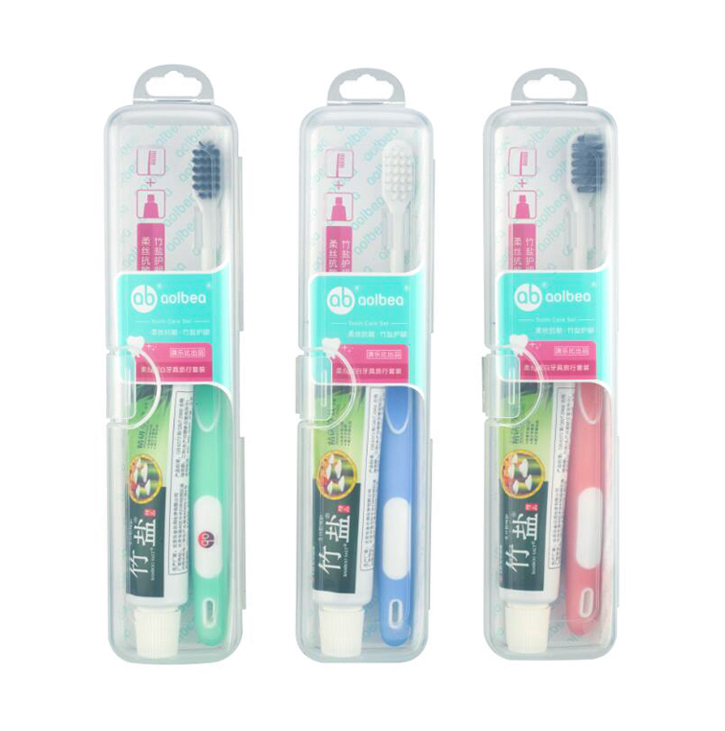
Travel-specific manual toothbrushes are engineered with a smaller footprint than standard toothbrushes. Most designs incorporate one of the following space-saving features:
- Foldable handle: The handle folds over the brush head to form a self-contained unit — typically 9 to 11 cm folded versus 18 to 20 cm for a standard toothbrush. The folded cap doubles as the handle extension when open.
- Integrated cap design: A protective cap snaps over the brush head for hygienic storage in a bag, eliminating the need for a separate travel case.
- Ultra-compact form: Some travel brushes weigh as little as 12 to 18 grams — a fraction of even the lightest battery-powered travel electric brushes at 80 to 150 grams.
For frequent travelers managing carry-on baggage or counting pack weight, this size and weight difference is practically significant — particularly on multi-destination trips where accumulation of small items adds up quickly.
Advantage 3: Airline and Security Compliant Without Any Restrictions
Manual travel toothbrushes pass through airport security without any special consideration. By contrast, battery-powered and electric travel toothbrushes are subject to restrictions:
- Lithium-ion battery devices must comply with airline-specific battery capacity limits (typically 100 Wh maximum for carry-on).
- Some security checkpoints require battery devices to be switched on for inspection, or removed from bags for scanning.
- Disposable battery toothbrushes may require batteries to be removed for checked luggage compliance on certain airlines.
A manual toothbrush involves none of these considerations — it is packed and forgotten, ready to use at the destination.
Manual travel toothbrushes are available at very low cost — typically under $3 per unit for quality travel designs, and often significantly less when purchased in multipack formats for frequent travelers or families. This low unit cost creates practical options that electric travel brushes cannot match:
- Disposable use: Many travelers deliberately leave their manual travel brush behind at the end of a trip, eliminating the need to pack a used brush for the return journey and freeing bag space.
- Hotel and hospitality amenity: Hotels, hostels, and guesthouses stock manual travel toothbrushes as standard bathroom amenities — a cost-effective solution that ensures guests always have access regardless of what they packed.
- Emergency backup: Keeping a spare manual travel brush in a desk drawer, glove compartment, or gym bag costs very little and eliminates the inconvenience of forgotten oral hygiene kit on short-notice trips.
Advantage 5: Effective Cleaning When Used with Correct Technique
While sonic electric brushes outperform manual brushes in clinical plaque-reduction studies, the margin is smaller than many assume when technique is correct. The modified Bass technique — angling soft bristles at 45 degrees to the gumline and using short, gentle circular strokes — removes plaque effectively on all tooth surfaces when applied consistently for the full two-minute recommended brushing duration.
For the duration of a trip, a manual travel toothbrush used correctly maintains oral hygiene at a level that prevents plaque accumulation from advancing to tartar or causing gum inflammation — the practical standard required, not a clinical trial benchmark.
Manual Travel Toothbrush vs. Electric Travel Toothbrush: When to Choose Each
| Criteria | Manual Travel Toothbrush | Electric Travel Toothbrush |
|---|---|---|
| Weight | 12–18 g | 80–150 g |
| Power required | None | Battery or USB charging |
| Airport security | No restrictions | Battery regulations apply |
| Cost per unit | Low (under $3 typical) | Higher ($15–$60+) |
| Usable without infrastructure | Yes (camping, remote travel) | Limited by battery life |
| Cleaning performance | Good (technique-dependent) | Very good (consistent) |
| Best suited for | Short trips, backpacking, emergencies | Extended trips with power access |